
From picking the right camp and real‑world expenses to every pitfall we hit over these two weeks
By Taylor | On‑site Research in the UK
If this is your first time sending your child to a summer camp in the UK, this is all you need to read.
My son Esen has just finished a two‑week summer camp in the UK. Over these two weeks, he grew tremendously, made new friends and gained much‑needed confidence.
In this article, I break down camp‑selection logic, real‑life costs, on‑arrival checklists, all the pitfalls we encountered plus my personal reflections. Save this if you are planning a UK summer camp for your child.
I. First Things First: How to Choose a UK Summer Camp
UK summer camps may look overwhelmingly diverse, yet they broadly fall into three categories. Figure out the camp type before comparing prices and making trade‑offs, or you risk being misled by flashy marketing.
① Private‑School‑Run Camps
Operated by UK independent schools using their own campuses and teaching staff. Esen attended Christ’s Hospital College, one of Britain’s oldest independent schools with a 474‑year history. Campers are predominantly from across Europe, alongside some participants from the Americas and Asia. Most programmes run in two‑week blocks: classes in the morning, followed by afternoon activities. Our group went on excursions to Cambridge, London, Oxford and Brighton.
② External Language‑School Camps
Held on language‑school premises or with host‑family accommodation, rather than on private‑school grounds. Even with morning classes and afternoon activities, most campers are still European. One realisation we had on‑site: many European campers are not native‑level English speakers. Having studied at an international school for years, Esen’s English was better than most of his European peers. Do not fixate solely on “private‑school branding”. Picking the right camp type matters more than chasing a big‑name institution.
③ Outdoor Adventure Camps
These prioritise physical and adventure‑focused activities such as kayaking, rock‑climbing and camping, with minimal language tuition. Usually the most budget‑friendly option. Ideal for families prioritising physical challenges and teamwork, with lower expectations for language instruction.
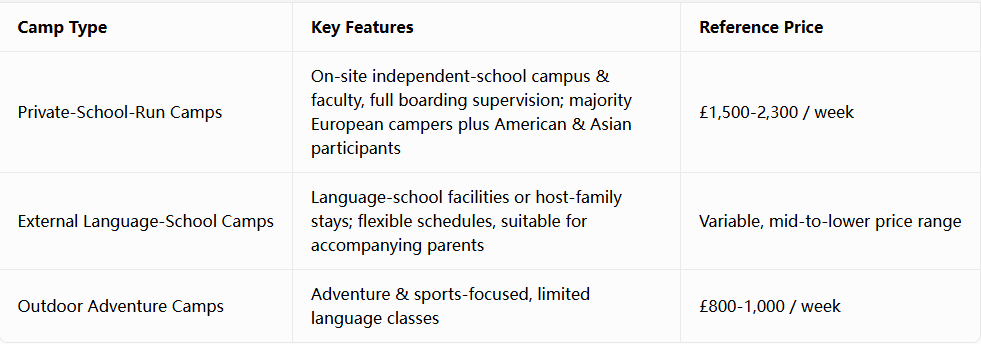
Note: The prices listed are public quoted rates, subject to seasonal, institutional and availability changes. For reference only. Always check official websites for up‑to‑date figures.
From Taylor
No category is inherently superior. Your choice hinges on your goals, your child’s age, and whether you will travel with them.
If parents are not accompanying, I tend to recommend private‑school‑run boarding camps: well‑established full‑board supervision offers greater peace of mind.
If you will travel alongside your child, external language‑school camps are a solid alternative with flexible costs, leaving you free to plan weekend family trips.
II. Two Weeks On‑Site: The Pitfalls We Experienced
Beyond camp selection, first‑time families struggle with little‑discussed practical logistics. Below are real‑world takeaways organised by scenario.
Mobile Data
You may buy SIM cards in advance on Taobao, yet these almost always come with restrictive data caps. Upon arrival, visit a local store for an EE or Voxi monthly plan (£25) offering unlimited data with roaming access across Europe.
Payments
You do not need large amounts of cash in the UK; card payments work for 99% of transactions. You must carry a Visa or Mastercard. UnionPay is rarely accepted; WeChat Pay and Alipay are mostly limited to Chinese restaurants and grocery stores. You can simply tap your credit card for underground, bus and train journeys.
Customs & Border Control
Prepare three documents ahead of arrival: camp acceptance letter, residential address, and return flight tickets. Border officers will typically ask about your length of stay, accommodation and your child’s camp. Straightforward answers will suffice.
Baggage Allowances
Intra‑European flights generally exclude checked luggage and only permit one cabin bag (40×20×25 cm). If you plan further travel within Europe after the UK, pre‑purchase checked‑bag allowance. Buying extra baggage at the airport is extremely expensive.
Sun Protection & Weather
Most historic British buildings — including the British Museum, rental apartments and trains — have no air‑conditioning. Indoor spaces can hit 33 °C during heatwaves, yet outerwear becomes necessary once the sun sets. Expect persistent strong winds combined with strong UV rays: pack sun protection and windproof outer layers. Local portable fans sell out quickly in hot weather. I paid £35 for a flimsy small fan.
If Your Child Falls Ill
For minor ailments: visit NHS‑registered community clinics marked with a cross; consultations are free for under‑16s. You may also purchase over‑the‑counter children’s medication affordably at Boots pharmacies. For serious conditions, hospital care is free, but waiting times can be lengthy. Secure travel insurance before departure to cover medical expenses.
Transport
Remember this tip: favour the Elizabeth Line. This modern line is air‑conditioned, clean, lift‑equipped and luggage‑friendly. Older London Underground lines are antiquated, un‑air‑conditioned and have spotty signal. Trains arriving at the same platform may head for different destinations — always check electronic departure boards. Regional trains can physically split into two sections heading for separate cities. Double‑check your carriage before boarding.
✅ Pre‑departure Packing List (Bring these from China where possible)
Small portable fan, complete sun‑protection gear (sun‑protective clothing, sun hat)
Windproof warm outerwear (British summers swing between hot and cold)
Basic over‑the‑counter children’s cold and fever medication
UK‑standard power adapters (far pricier locally)
A Visa or Mastercard credit card
Physical print‑outs of all key documents: flight tickets, accommodation address, camp contact details and itineraries. Do not rely purely on digital copies.
III. What Matters More Than English‑Language Improvement
Beyond practical tips, here is what I most want to share.
What Is the Real Purpose of Summer Camp?
Many parents send their children to summer camp expecting substantial knowledge gains and rapid English progress. From my real‑world experience: genuine academic progress over two weeks is limited, and that should be realistic. The true value lies elsewhere: connecting with peers globally, exposure to diverse cultures, and igniting motivation for language‑learning.
Esen spent most of his camp time with European classmates. They played football together, and he saw firsthand how skilled many European young players are. This real‑world realisation — that others excel in areas he does not — cannot be taught from textbooks.
We later travelled across Europe and met tourists from Croatia and other nations. Strangers offered to take our photos and struck up casual conversations. These small moments made my child feel how vast the world is, and how easy cross‑cultural interaction can be. Such lived experiences foster personal growth far beyond textbook knowledge.
The Core Value Lies in Boarding Camp
Many parents debate whether to stay with their child the whole time. My observation: the greatest value of summer camp emerges when children live independently on‑site. For those two weeks, you can comfortably step back. Reputable camp staff handle airport pick‑ups. You may even send your child ahead unaccompanied to be met by camp staff, and join them only for graduation.
Once camp concludes, I highly recommend travelling around continental Europe with your child. France, Italy, the Nordic states — each has its own unique charm. I believe every child deserves a European summer. History, stories and world heritage sites feel completely different when you stand physically there, compared with reading about them in books.
Book tickets well in advance for iconic sites such as Sagrada Família and the Louvre, especially for tower access; slots sell out fast in summer. Hiring a professional guide makes an enormous difference to children’s understanding; children aged 8 + can engage well with guided tours. Professional family photoshoots are widely available across Europe at reasonable rates (roughly CNY 1,000+).
Language as a Key to Culture
Travelling around continental Europe, I noticed local residents’ English proficiency varies greatly, and many spoke less fluently than Esen. This observation boosted my perspective on language learning: if children have capacity, encourage them to pick up an additional foreign language.
Languages open doors to cultures. Saying Bonjour and Merci in France, or Hola and Gracias in Spain creates real‑life context. Back home, their learning motivation shifts. They are no longer memorising vocabulary for exams. They understand language is a key to another world.
“Travel is fatal to prejudice, bigotry, and narrow‑mindedness.”
— Mark Twain